


Uplighter (Freestanding / Wall Mounted) |
||||||||
|
||||||||
| How to buy | ||||||||
| Enquire |
Product Description
The relationships that Geoffrey Bawa’s lighting designs have with objects and spaces are not easy to recreate. Unlike modern-day lighting solutions designed to flood rooms, his lighting was an active, structural participant in a space. Functioning as both actor and playwright, these lamps choreographed light and soft-edged shadows to guide the eye through the space, and directed the viewer’s gaze to highlight either their own form, or those of the objects placed in their light.
Phantom Hands’ re-edition of the Uplighter—available both as a freestanding floor piece and as a wall-mounted fixture—retains the metal shell of the original but clads it in two shades of hand-stitched silk from Zanav: Haveli Ivory on the inside, and Haveli Natural on the exterior. The freestanding version has a heavy rectangular brass base that acts as a physical counterweight, keeping the uplighter shell stable on flat surfaces. The shell is mounted on the base at an angle that maximizes the projection of light. The wall mounted version uses a cleat mounting system with two interlocking brass strips. One brass strip attaches to the wall; the second, to the uplighter shell, allowing it to neatly slot into the wall-mounted strip. This creates a clean, flush-to-the-wall look.
The material play of metal and silk, the spare form, and the warm, orange-tinged light all go towards creating the very Sri Lankan style of lighting Bawa was particularly adept at—where pools of shadow alternate with bars of light and draw the eye towards treasured objects.
The Uplighter is also available as a variant with an artefact stand.
Product Specification


Related Products
See More

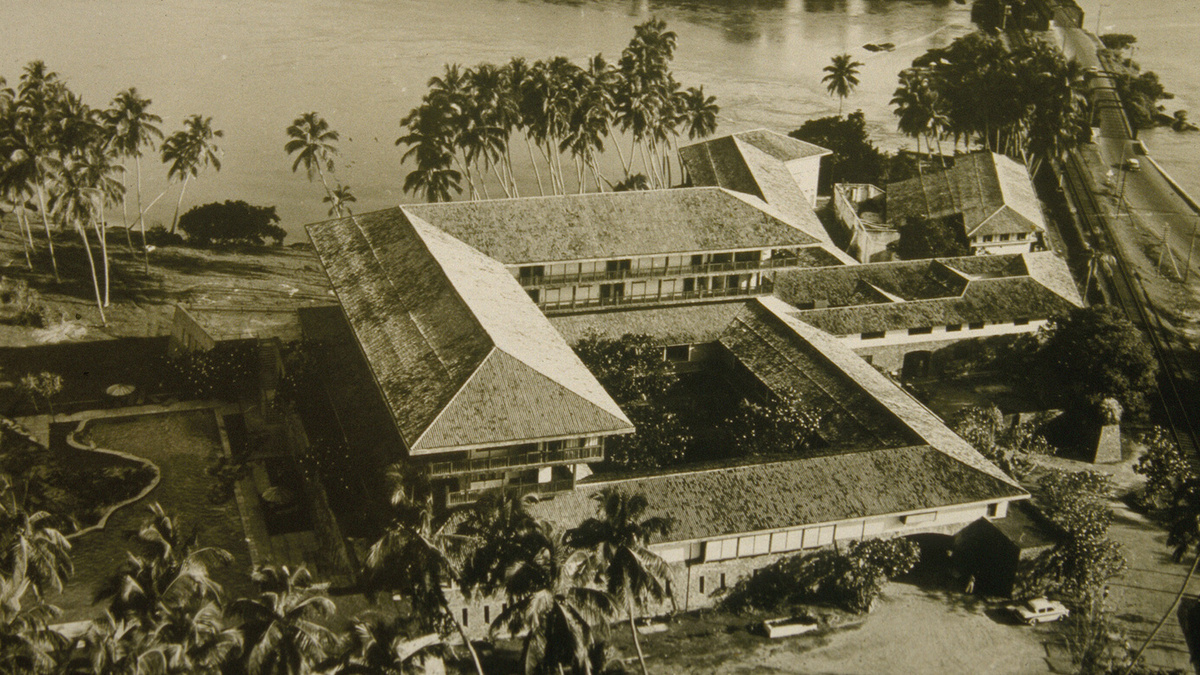
Geoffrey Bawa’s Design Legacy: How Sri Lanka’s Modernist Pioneer Shaped Furniture, Interiors, and Hospitality in South Asia
In post-independence Sri Lanka, Geoffrey Bawa redefined what modern design could mean in a newly self-determining nation. Working within economic restrictions and social upheaval, he created architecture and furniture that reflected both resourcefulness and restraint — work that continues to shape the region’s design language today.
Read More