


Uplighter (With Artefact Stand) |
||||||||
|
||||||||
| How to buy | ||||||||
| Enquire |
Product Description
When Phantom Hands’ co-founder Aparna Rao describes Geoffrey Bawa’s lighting design she keeps returning to a single idea: how he designed for a particular quality of light from a lamp, rather than the lamp itself. “There are many lamps that look beautiful because they’re nice objects,” she says, “but what struck me about Bawa’s lamps was that the function of the light itself was very original—it was meant to draw attention to something very specific in the room. In the process, it also created a layered spatial experience.” Once Rao spotted the pattern running through the designs, she was electrified by the thought of adding them to Phantom Hands’ Geoffrey Bawa Collection. She took the idea to Channa Daswatte, Bawa’s last associate, who validated both her idea, and the singularity of thought behind the designs. “Bawa never designed a lamp with the idea of designing a lamp,” Daswatte recalls. “It was always because he saw something he wanted to highlight—a handcrafted object, a texture, a particular form—the lamp was simply the means to do it.”
Bawa’s original uplighter, like most of his designs, was created because of a problem he was trying to solve. Among the many artefacts he had in his Colombo home was an antique stone frieze that he wanted to highlight. A spotlight, Bawa felt, would be too harsh for its bas relief, so he came up with the idea of a curved horizontal metal shell with a single bulb that would let the light wash upwards. Mounted on the base of a pair of metal wires that extended into a vertical, rectangular loop, the shell would softly direct the light onto the frieze, which rested against the loop—like a book against a bookend. The lamp itself was meant to be inconspicuous.
Phantom Hands’ version of this uplighter recreates the artefact stand in brass. It also retains the metal shell of the original but clads it, inside and out, in hand-stitched silk. The material play of metal and silk, the spare form, and the warm, orange-tinged light all go towards creating the very Sri Lankan style of lighting Bawa was particularly adept at—where pools of shadow alternated with bars of light, inviting the eyes to rest on treasured objects.
The Uplighter is available in two additional variants: a freestanding, and a wall mounted version.
Product Specification


Product Details
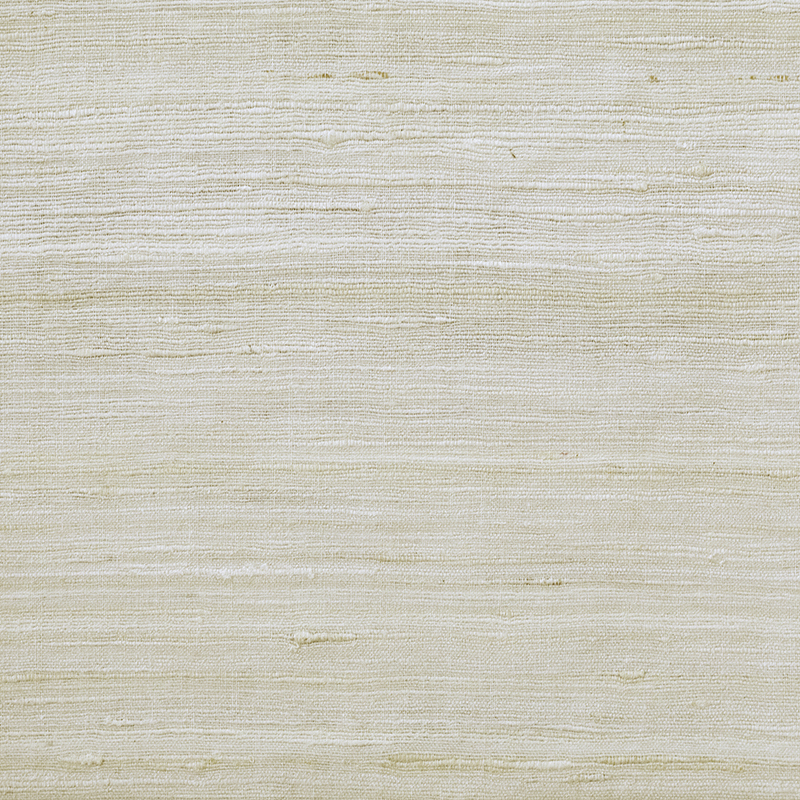
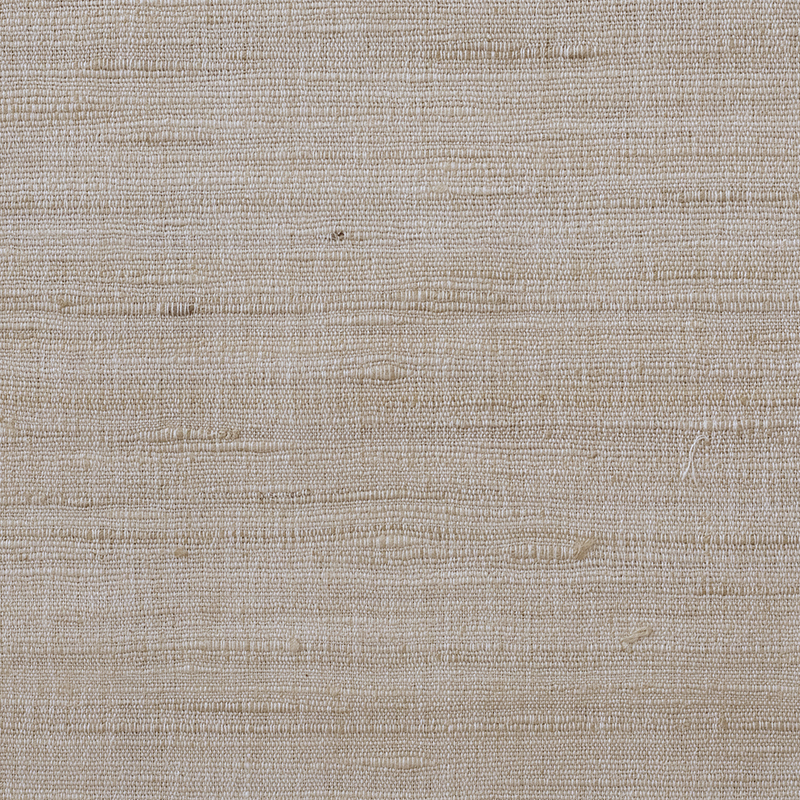
The metal shell of the uplighter is clad in hand-stitched silk fabric from Zanav—Haveli Ivory on the inside, and Haveli Natural on the exterior.
Uplighter Shell Fabrics
Related Products
See More


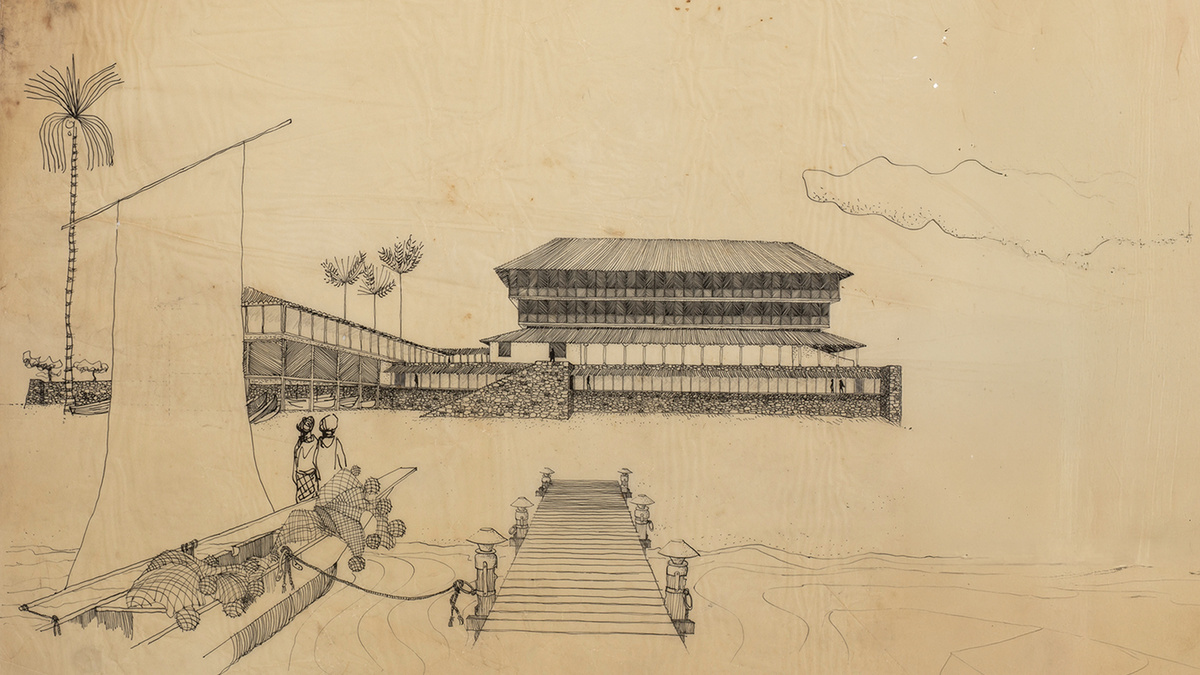
Opening Lines: In Geoffrey Bawa’s Design Process, Drawing Was a Starting Point to Spark Dialogue
For Geoffrey Bawa, drawing was a way of thinking—a starting point for a dialogue with ideas, objects, site and material. In his practice, ideas for buildings, furniture and objects alike, developed through scribbled sketches—in letters, on tracing paper, and even on some occasions, on the ground, using his walking stick.